
AI is revolutionising drug discovery across the biopharma landscape. Many organisations are developing specialised AI agents and Gen-AI powered tools to extract insights from complex multi-omics data, to accelerate biomarker identification, drug discovery and precision medicine research.
However, these efforts are often siloed even within an organisation, diminishing the usability of an institution’s knowledgebase for faster precision insights for target and biomarker identification. Major biopharmaceuticals continue to face key challenges in:
- integrating multi-modal data and scaling AI across R&D;
- getting consistent disease insights across internal and external studies, and;
- fully harnessing their proprietary knowledgebases to accelerate research using their AI tools.
To further complicate target discovery, multi-omics data itself is vast, cluttered, and interconnected, making it difficult and time-consuming to find significant drug–target associations for biomarker identification.
Challenges in Extracting Precision Insights from Complex Multi-Omics Data
A lot of conventional visualisation and analytical tools, such as an enrichment analysis, leverage ontologies to mine complex multi-omics data.
Gene Ontologies are structured vocabularies that describe the role of genes and gene products at the molecular, cellular and tissue level. An enrichment analysis leverages the structured knowledge contained within ontologies to highlight over-represented biological functions or processes.
This enables scientists to gain contextual insights such as Genes–to–Pathways, –Disease, and –Drug associations, supporting biomarker discovery and validation.
However, the growing volume of continuously updated public and proprietary data spread across various databases has resulted in fragmented and cluttered outputs, making it increasingly difficult to:
- navigate complex information and draw significant connections between disease–target and drug–target associations;
- prioritise biomarkers for validation;
- contextualise data to understand disease or drug mechanisms;
- leverage consolidated knowledgebases to predict drug–target associations, and;
- improve clinical trial designs by identifying patient subgroups most likely to be drug responsive, based on their biomarker profile.
The Solution: Knowledge Graphs
Knowledge graphs (KG) are graph databases that address these issues by transforming multi-dimensional biological data into a network of inter-connected nodes. In biomarker identification and drug discovery, knowledge graphs enable—
- Multimodal Data Integration: Knowledge graphs integrate multimodal data from diverse sources, providing researchers with a unified integration layer for all their internal and external data.
- Reveal Hidden Data Patterns: By organizing data into interconnected nodes, knowledge graphs make it easier to uncover hidden association patterns.
- Contextualised Findings: Knowledge graphs link entities such as genes, proteins, drugs, diseases, pathways, and more in a single network, providing a comprehensive context to interpret potential biomarkers for drug discovery.
- Improved Drug–Target Predictions: Knowledge graphs leverage existing drug information to predict novel drug-target interactions and identify opportunities for repurposing drugs with similar mechanisms of action.
- Improved Clinical Trial Designs: By integrating biomarker profiles and clinical features, knowledge graphs help identify patient subgroups most likely to respond to specific treatments, enabling more targeted and effective clinical trials.
- AI-driven Drug Discovery: Knowledge graphs provide a seamless searchable layer that is readily accessible to AI/ML-based agents for accelerated exploratory insights.
Knowledge graphs structure data and data interactions as nodes, edges, and labels. These data components serve a dual purpose: they help in contextualizing findings, and are easily ML-accessible. AI/ML-based algorithms can:
- cluster data from knowledge graphs hierarchically,
- provide new links that are otherwise unapparent, and
- provide researchers with a framework of recommendations for next steps in drug discovery.
Knowledge graphs are thus gaining increasing popularity in drug discovery since they accelerate biomarker validation. Combined with GenAI-powered tools, knowledge graphs refine an unmanageable number of leads down to a few significant targets. They can de-noise data up to 28X, improving the clarity of final results, and accelerate R&D pipelines.
Knowledge Graphs on Quark
Quark Knowledge Graphs provide an AI-powered, ontology-based unifying data management framework, facilitating natural language-based queries that accelerate advanced actionable insights by 20X.
Knowledge Graphs on Quark are powered by specialised GenAI-tools that specifically address key bottlenecks in drug discovery and biomarker identification; for example, researchers across an organization can instantly access advanced exploratory insights with a single-click.
With Quark Knowledge Graphs, researchers can—
1. Bring their Own Proprietary Data
Researchers can augment publicly available data with their own continuously updated proprietary data, fully leveraging both to maximise actionable insights.
2. Reveal Top Gene, Expression, and Mutation Associations with Disease, Pathways, and Drugs
As shown below, researchers can select between different knowledge graph layouts to visualise the top 5, 10, or 20 genes with the highest log2fold changes and their disease, pathways, and drug associations.
This is represented as a clustered network of interactions.


Top 10 or top 20 gene–to–disease, –drugs, and –pathway associations viewable in different Knowledge Graph layouts
3. Automatically Generate AI-Powered Insights
With Quark, researchers can now leverage AI/ML-based algorithms to bridge the gap between their proprietary data and biomarker identification. Quark’s AI-powered knowledge graphs automatically summarize and contextualise findings, enabling researchers to quickly gain early exploratory insights.
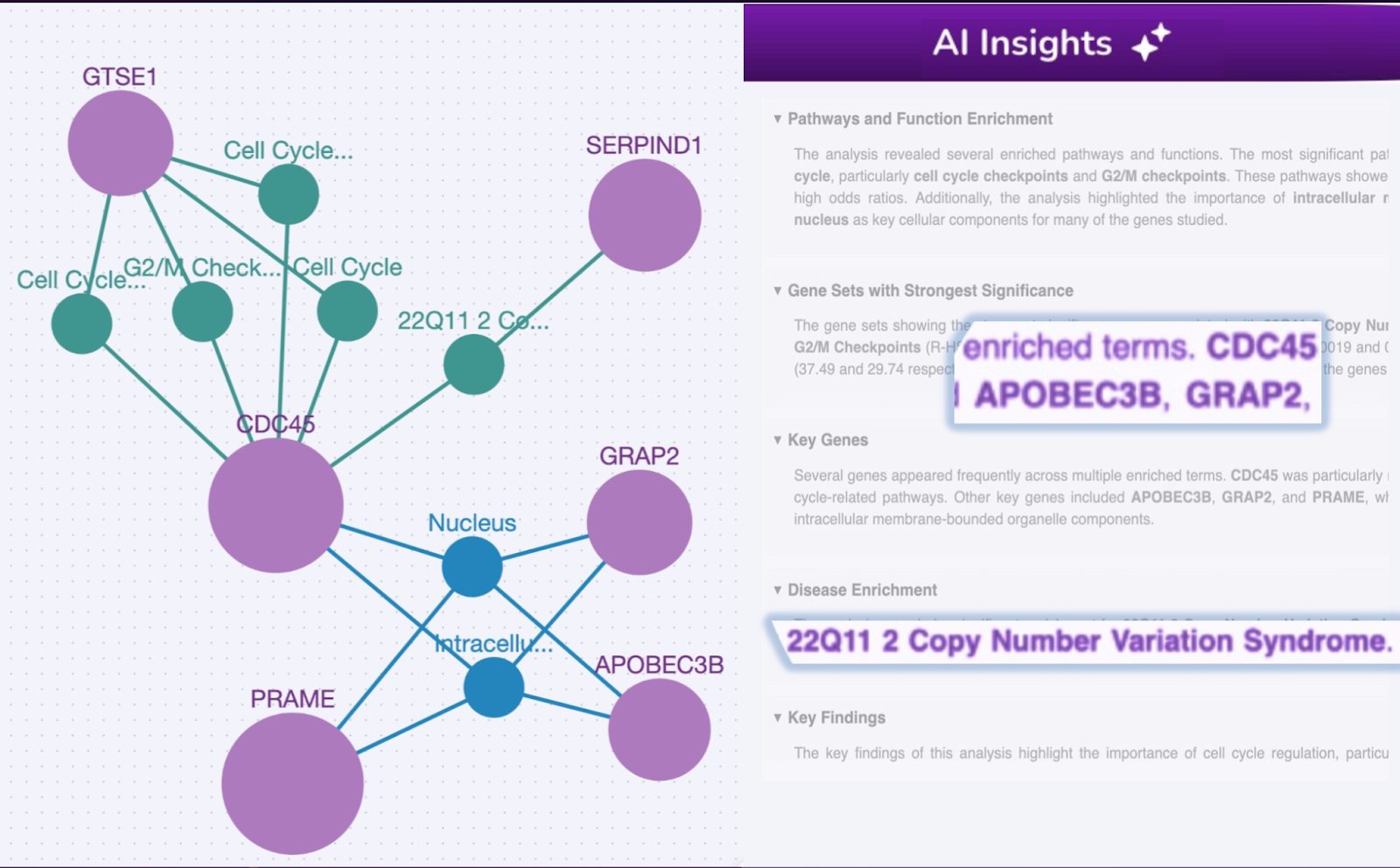
Automatically get AI-powered faster disease insights
4. Query Knowledge Graphs Using Natural Language-based Interactions
Quark’s Knowledge Graphs integrate multimodal data from diverse sources, providing a seamless searchable layer that researchers can query using Natural Language-based interactions.
Based on a specific area of research, scientists can tailor questions to streamline their findings, accelerating their research by 20X.
Thus, in addition to AI-powered insights, scientists can systematically generate hypotheses and perform exploratory analysis.
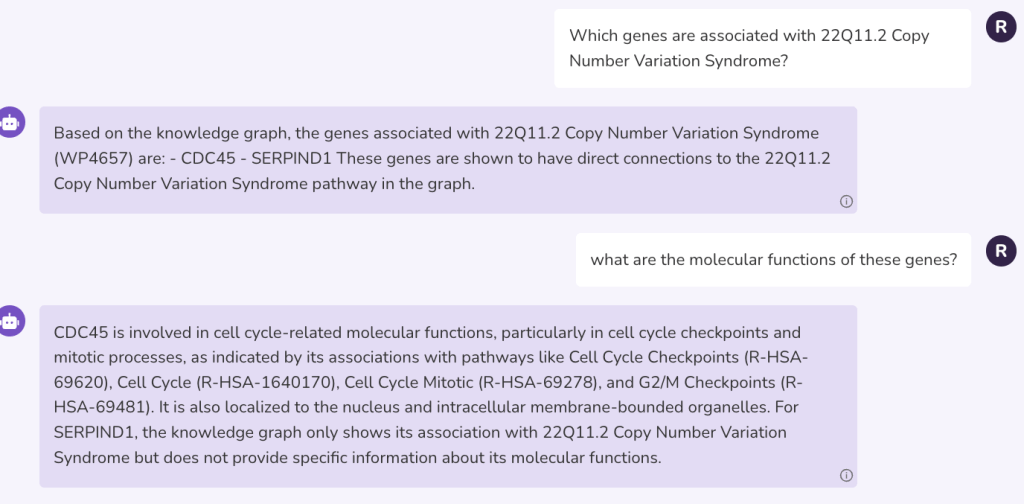
Natural Language-based interactions with Quark’s Knowledge Graphs streamlines research findings and accelerates exploratory insights 20X
5. Create New Cohorts by Searching for Genomic and Clinical Metadata
Scientists can now query their knowledge graphs on Quark to rapidly create cohorts for exploratory analysis.
Based on genomic and clinical metadata, researchers can identify patient samples that meet their inclusion criteria for addressing specific research questions.
For example, researchers can leverage target insights gained from their knowledge graphs, to identify a patient subgroup that would respond to a drug treatment (as illustrated below).

Leverage AI- and NLP-powered Knowledge Graph insights to identify and build cohorts based on genomic and clinical metadata parameters
Conclusion
Knowledge Graphs are powerful cluster representations that uncover hidden patterns of genes–to–disease, –pathways, and –drug associations in complex multi-omics data. Combined with GenAI, knowledge graphs are rapidly gaining popularity for accelerating biomarker identification in precision medicine and drug discovery.
With Quark’s Knowledge Graph, scientists can not only gain rapid disease insights, they can also leverage the unifying data management framework it provides for natural language-based interactions. Quark additionally enables an organization to bring their proprietary data to augment publicly available resources.
Researchers can build specialised knowledge graphs for specific areas of research — getting consistent disease insights across internal and external studies, while at the same time continuously updating their graphbase through positive feedback loops using natural language.
Quark’s Knowledge Graphs instantly bring the latest functional and disease insights to key stakeholders throughout an organisation. This prevents needless replication of cost- and compute-intensive multi-omics analyses.
Quark thus provides a unified and searchable integration layer for multimodal data through knowledge graphs, facilitating the effortless scaling of GenAI-powered drug discovery across R&D.
Find out more about our AI-Powered Knowledge Graphs by scheduling a demo.