


The Challenge
The crux of multi-omics data analysis is getting actionable insights for drug discovery and biomarker validation. However, the recent explosion of multi-dimensional data has challenged traditional approaches to getting research insights, paving the way for AI-powered insights.
For example, frequently used tools like enrichment analysis can unlock endless avenues of target discovery from multi-dimensional data. However, their intended application of addressing specific research questions becomes obscured under mountains of potential discoveries.
Before addressing this challenge, it’s important to understand what an enrichment analysis is and how it uses ontologies to navigate data and provide actionable research insights.
Ontologies and their Importance in Biomedical Research
Ontologies are structured vocabularies that categorise and provide crucial pieces of information about a term. Gene ontologies (GO) build a global picture about a gene in three categories: Molecular Functions, Biological Process and Cellular Components.
An enrichment analysis leverages the structured knowledge within gene ontologies to contextualise and extract research insights from a list of genes. By mapping a gene list to known molecular functions, pathways and interactions, an enrichment analysis highlights statistically significant over-represented ontologies and highlights key contextual features that connect a list of genes.
Gene ontologies integrate data from diverse sources of information to provide a standardised framework that improves data interoperability.

Multiple layers or sources: Ontologies connect data from different sources, allowing researchers to connect complex information. (Source: Bonner et al., 2022)
However, massive volumes of multi-dimensional data means that an enrichment analysis can lead researchers down a large number of gene-function relationships to extract insights. This becomes a challenging prospect for researchers to—
- Methodically navigate a set of genes,
- Pinpoint connections between gene ontologies that would contextualise a set of differentially expressed genes, and
- Rank targets for further experimental validation.
Leveraging genAI to Generate Exploratory Insights
GenAI leverages the structured knowledge within gene ontologies to navigate large volumes of complex, multidimensional data.
Gene ontologies directly harness a powerful capacity of genAI. Not only can genAI integrate data from diverse, multiple databases, it also identifies the underlying connections or relationships between various genes in a set of genes, allowing researchers to:
- Access knowledge-driven research insights that are contextual;
- Understand the mechanism of action of potential drug targets;
- Fill in missing knowledge-gaps in their data, as genAI can make inferences and complete partially available knowledge;
- Prioritize the most relevant leads for biomarker validation, and;
- Further query their data by leveraging genAI ability to mine ontologies and make powerful logical inferences.
GenAI on Quark: Maximising Insights from Enrichment Analysis
Quark’s mission is to help scientists reach actionable insights faster. With a single-click, researchers can instantly access advanced, powerful and contextually aware exploratory insights from their gene sets.
The images below illustrate the simplicity of Quark’s intuitive interface and the power of GenAI combined with enrichment analysis.
Enrichment Analysis on Quark
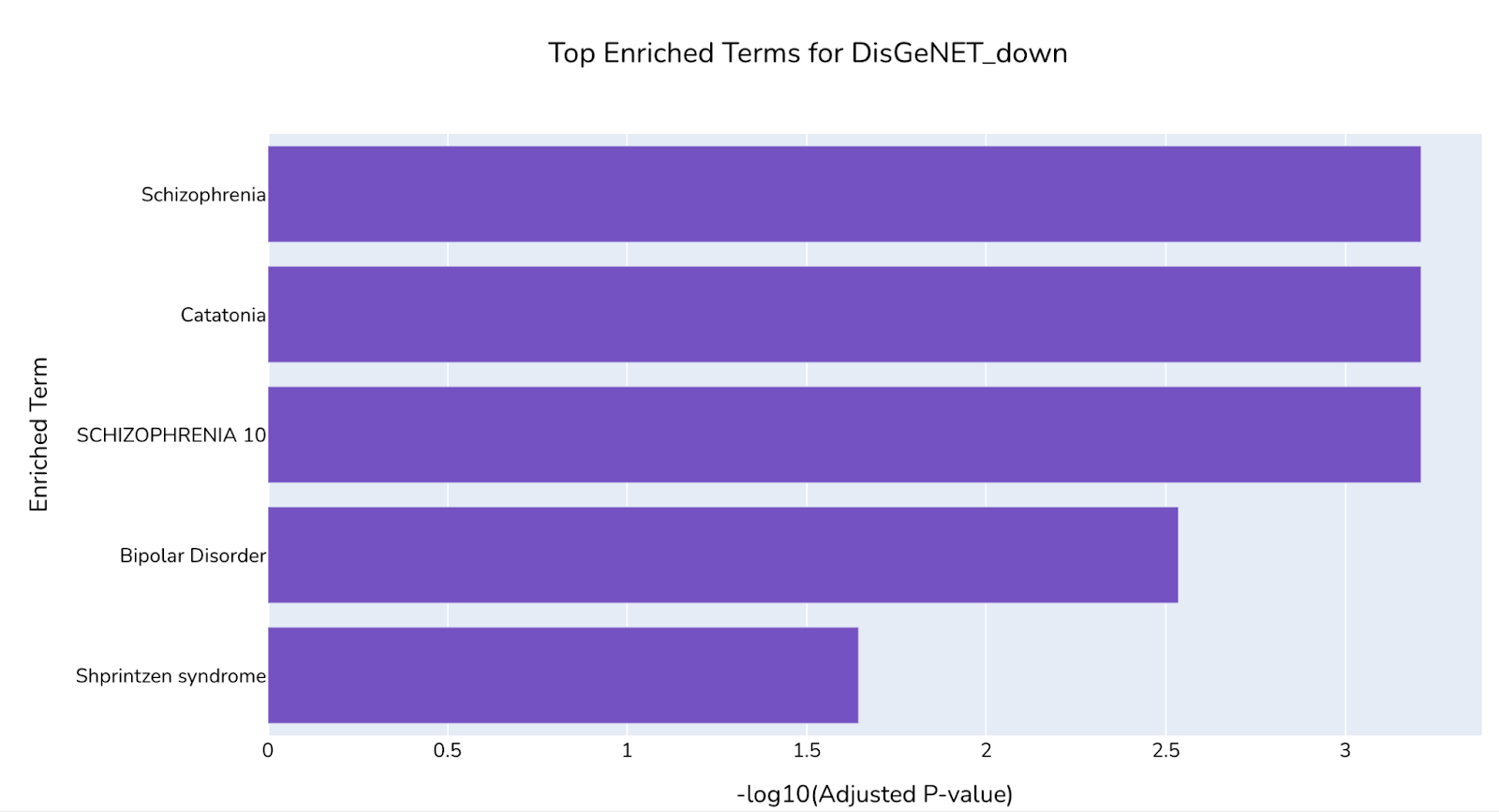
Leveraging GenAI for Exploratory Insights: AI uses ontologies to instantly analyse massive datasets and prioritise key findings for biomarker validation


Quark’s GenAI thus analyses massive datasets, prioritizes the most relevant features and delivers key exploratory insights about target biomarkers — all within the same interface.
To learn more about Quark, please request a demo.